The Méthode Champenoise: Precision in Effervescence
Unveiling the intricate steps of tirage, dégorgement, and dosage in sparkling wine production.
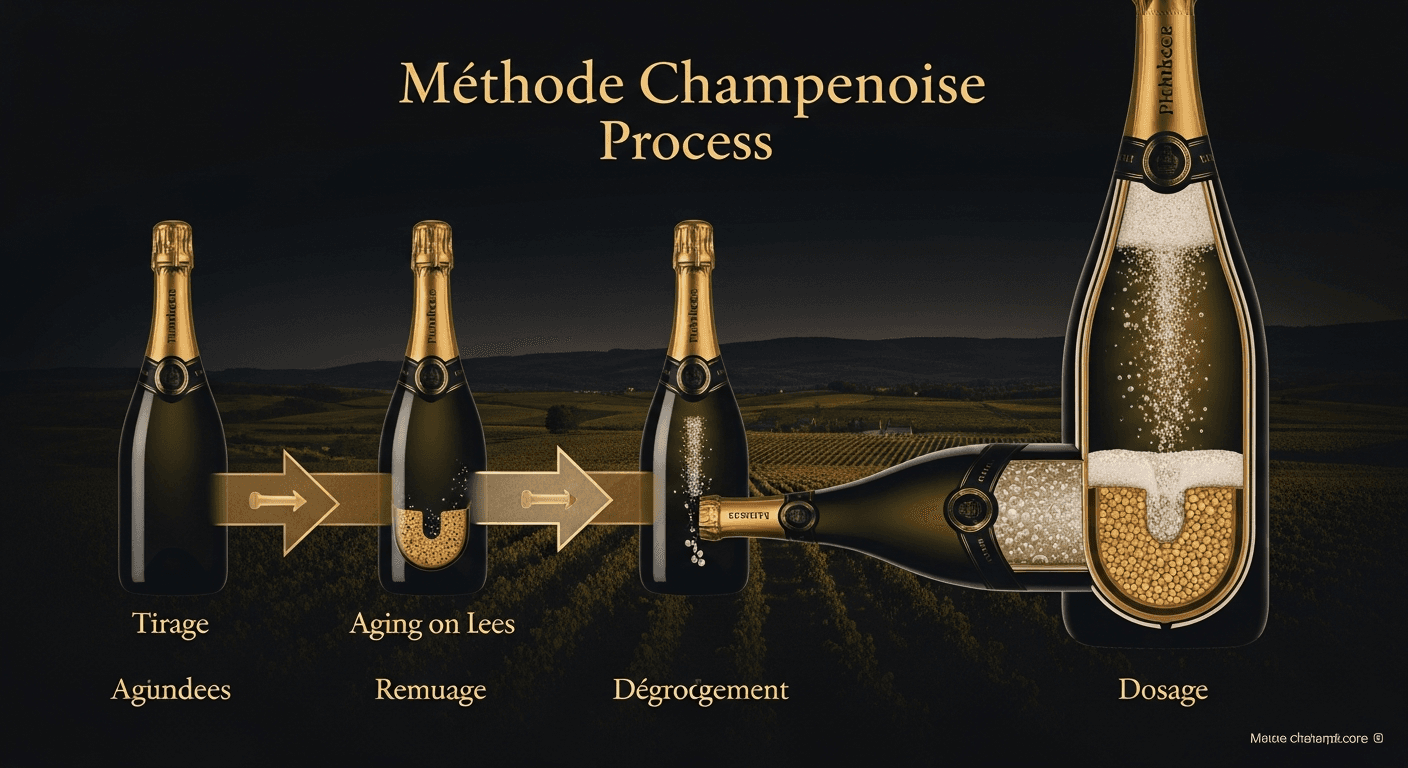
Imagine a world where sparkling wine was a perilous gamble, where up to 80% of bottles might explode during fermentation, a common occurrence in 1828 due to inconsistent glass and unpredictable processes. This precarious past underscores the remarkable evolution of the Méthode Champenoise, a testament to human ingenuity in taming nature's effervescence. Today, this traditional method, legally reserved for wines from the Champagne region of France, relies on a trio of meticulously controlled stages-tirage, dégorgement, and dosage-each critical to crafting the world's most revered sparkling wines.
The Genesis of Bubbles: Tirage
The journey to effervescence commences with tirage, the French term for drawing off the still base wine, known as vins clairs, into individual bottles for a second alcoholic fermentation. To initiate this crucial transformation, a carefully formulated liqueur de tirage is introduced: a blend of still wine, precisely measured sugar, and selected active wine yeast strains, often Saccharomyces cerevisiae varieties like Lalvin EC-1118. The standard addition is approximately 24 grams of sugar per litre of blended wine, a quantity designed to produce a formidable pressure of around 6 atmospheres, or 75-90 pounds per square inch, inside the sealed bottle. This secondary fermentation not only generates the characteristic carbon dioxide bubbles but also increases the wine's alcohol content by about 1.2-1.3%. Following this, the bottles are laid horizontally in cool cellars, typically at 9-12 °C, for an extended period of maturation sur lie, allowing the dead yeast cells to undergo autolysis, imparting complex notes of brioche, toast, and a creamy texture.
The Art of Clarification: Dégorgement
After months, or even years-a minimum of 15 months for non-vintage Champagne and at least three years for vintage expressions-the wine is ready for clarification. This involves remuage, or riddling, a process developed around 1818 by Madame Clicquot and her employee Antoine Muller, who reputedly used a kitchen table with angled holes to collect the yeast sediment in the bottle's neck. Traditionally, a remueur would manually rotate and tilt up to 60,000 bottles daily over several weeks. Modern production largely employs automated gyropalettes, introduced in 1973, which can riddle 504 bottles simultaneously, mimicking the precise movements of manual riddling. Once the sediment is consolidated, the next critical step is dégorgement, the removal of these spent yeast cells. The most common method, dégorgement à la glace, involves freezing the bottle neck in a brine solution at temperatures as low as -27 °C, creating an ice plug that encapsulates the sediment. The crown cap is then removed, and the internal pressure expels the frozen plug, leaving a clear wine. A more traditional, labour-intensive method, dégorgement à la volée, is still practiced for larger formats or exceptional Cuvées, requiring a skilled hand to quickly open and reseal the bottle.
The Final Flourish: Dosage
The momentary void left by disgorgement, and the inherent acidity of the wine, necessitate the final, delicate adjustment: the dosage. This involves adding a small quantity of liqueur d'expédition, a proprietary blend of reserve wine and pure cane or beet sugar, though other additives like SO2 or citric acid may also be included. Each Champagne house guards its specific recipe, often utilising reserve wines aged for at least two years to achieve a consistent house style and add complexity. While often perceived as merely sweetening the wine, the primary role of dosage is to balance the high acidity, round out the palate, and enhance the wine's overall harmony. Historically, Champagnes were considerably sweeter; however, consumer preferences have shifted towards drier styles over the past century.
Sweetness levels are strictly defined by EU regulations, ranging from the bone-dry Brut Nature (0-3 grams of sugar per litre, with no added sugar) to Doux (more than 50 g/L). The most prevalent style today, Brut, contains less than 12 g/L of sugar. It is worth noting that Extra Dry, despite its name, is actually slightly sweeter than Brut, typically containing 12-17 g/L. After the dosage, the bottle is sealed with its final cork and wire cage, often resting for another few months to allow the liqueur d'expédition to integrate seamlessly with the wine.
The Méthode Champenoise is a symphony of precision, patience, and tradition. The next time a glass of fine sparkling wine is raised, consider the meticulous journey it has undertaken: from the precise addition of liqueur de tirage that sparks its effervescence, through the diligent remuage and dramatic dégorgement that clarifies its essence, to the subtle art of dosage that perfects its balance. These steps are not merely technical procedures; they are the soul of a wine style that continues to captivate palates worldwide, inviting a deeper appreciation for the craft in every delicate bubble and nuanced flavour.
More from the cellar.
Bottle Shock: The Unseen Travail of Transported Wine
Unravelling the debate: does wine truly need repose after its journey?
The Enduring Effervescence of an Open Bottle
Unravelling the science and art of preserving sparkling wine's ephemeral magic.
The Silent Saboteurs of Sparkling Grandeur
Preserving the delicate effervescence of Champagne demands precise, consistent care.