Pinot Meunier: Champagne's Unsung Essential
Beyond its supporting role, this resilient grape offers vital character to the region's finest bubbles.
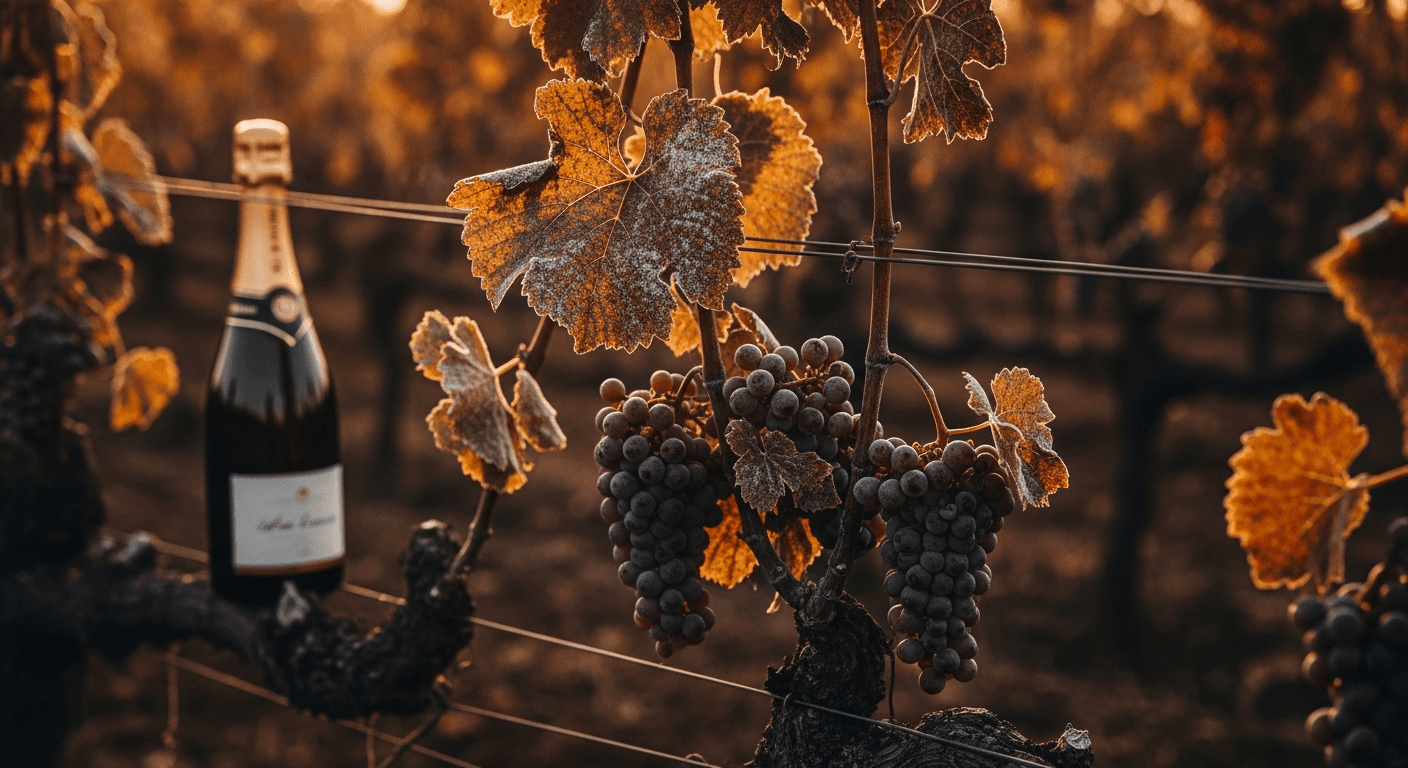
For generations, Pinot Meunier has been relegated to the background, often considered Champagne's pragmatic 'third wheel,' a mere workhorse grape overshadowed by the perceived nobility of Chardonnay and Pinot Noir. Yet, this perception belies a profound historical and viticultural truth: for much of the 19th and 20th centuries, Pinot Meunier was the most widely planted grape in Champagne, at one point accounting for over 40% of the region's total plantings. Its quiet resilience and fruit-forward charm have long been indispensable, even if rarely celebrated.
The grape's very name, 'Meunier,' meaning 'miller' in French, derives from the distinctive flour-like white down found on the underside of its leaves. Ampelographical studies have revealed it to be a chimeric mutation of Pinot Noir, sharing a close genetic lineage while possessing unique characteristics. This ancient lineage is documented as far back as the 16th century, establishing its long-standing presence within France's viticultural landscape.
Meunier's prevalence in Champagne is not accidental; it is a testament to its exceptional hardiness and adaptability to the region's often challenging climate. It exhibits a later bud-break and earlier ripening cycle compared to Pinot Noir and Chardonnay, rendering it less susceptible to the devastating spring frosts and coulure that can plague the vineyards. This makes it particularly vital in cooler, frost-prone areas such as the Vallée de la Marne, where it thrives in clay-rich soils and constitutes a substantial 60-70% of the vineyard area.
The Heart of the Blend
In the traditional Champagne assemblage, Pinot Meunier plays a crucial role, contributing essential aromatics and a generous, supple fruitiness to the cuvée. It imparts notes of tart cherry, raspberry, apple, and sometimes a subtle smoky character, which serve to soften the structural austerity of Pinot Noir and round out the lean elegance of Chardonnay. This 'plush texture' and approachable fruit profile make it particularly valuable in non-vintage Champagnes, allowing them to be enjoyed relatively young while still offering complexity and balance.
Historically, the notion that Meunier-dominant Champagnes lacked aging potential was widely accepted, leading many Grand Marques to minimise its presence in their vintage and prestige cuvées. However, this viewpoint is being rigorously challenged by a new wave of dedicated grower-producers. Houses such as Krug have long demonstrated Meunier's capacity for longevity, incorporating a significant proportion-often 20-25%-into their famed Grande Cuvée, and even 21% in their highly-rated 2002 vintage. More recently, in 2018, Gosset, a house traditionally focused on Pinot Noir and Chardonnay, released a 100% Meunier from the 2007 vintage, proving its ability to age gracefully for over a decade.
Meunier's Solo Performance
The past two decades have witnessed a profound shift, with many growers championing Pinot Meunier as a single-varietal expression, often crafted as Blanc de Noirs. This movement, championed by the Meunier Institut, founded in 2015 by Eric Taillet, seeks to elevate the grape's status beyond its blending utility. Producers like Jérôme Prévost with his renowned 'Les Béguines', Tarlant with 'La Vigne d'Or' from vines planted in 1947, and Laherte Frères' 'Les Vignes d'Autrefois' from old vines dating back to 1947-1953, are showcasing Meunier's nuanced character: a vibrant interplay of orchard fruit, spice, and often an underlying minerality. These wines, frequently rendered in extra-Brut styles with minimal dosage, offer a pure, unadulterated glimpse into the grape's expressive potential.
Today, Pinot Meunier accounts for approximately 31-32% of Champagne's total vineyard area, a share comparable to Chardonnay's 30-31% but slightly less than Pinot Noir's 38%. As global climates continue to shift, Meunier's inherent resilience and consistent ripening characteristics make it an increasingly relevant and valuable asset for Champagne. For the discerning club member, seeking out these distinctive 100% Meunier cuvées offers a remarkable opportunity to explore a hitherto underestimated facet of Champagne's diverse and evolving landscape. They are a testament to the fact that even the most unassuming components can, when given due attention, reveal extraordinary depth and individuality. Seek them, savour them, and discover the true soul of this remarkable grape.
More from the cellar.
Bottle Shock: The Unseen Travail of Transported Wine
Unravelling the debate: does wine truly need repose after its journey?
The Enduring Effervescence of an Open Bottle
Unravelling the science and art of preserving sparkling wine's ephemeral magic.
The Silent Saboteurs of Sparkling Grandeur
Preserving the delicate effervescence of Champagne demands precise, consistent care.