Franciacorta: Italy's Alpine Sparkling Secret
Nestled at the foot of the Alps, this Italian *Méthode Classique* gem awaits discovery.
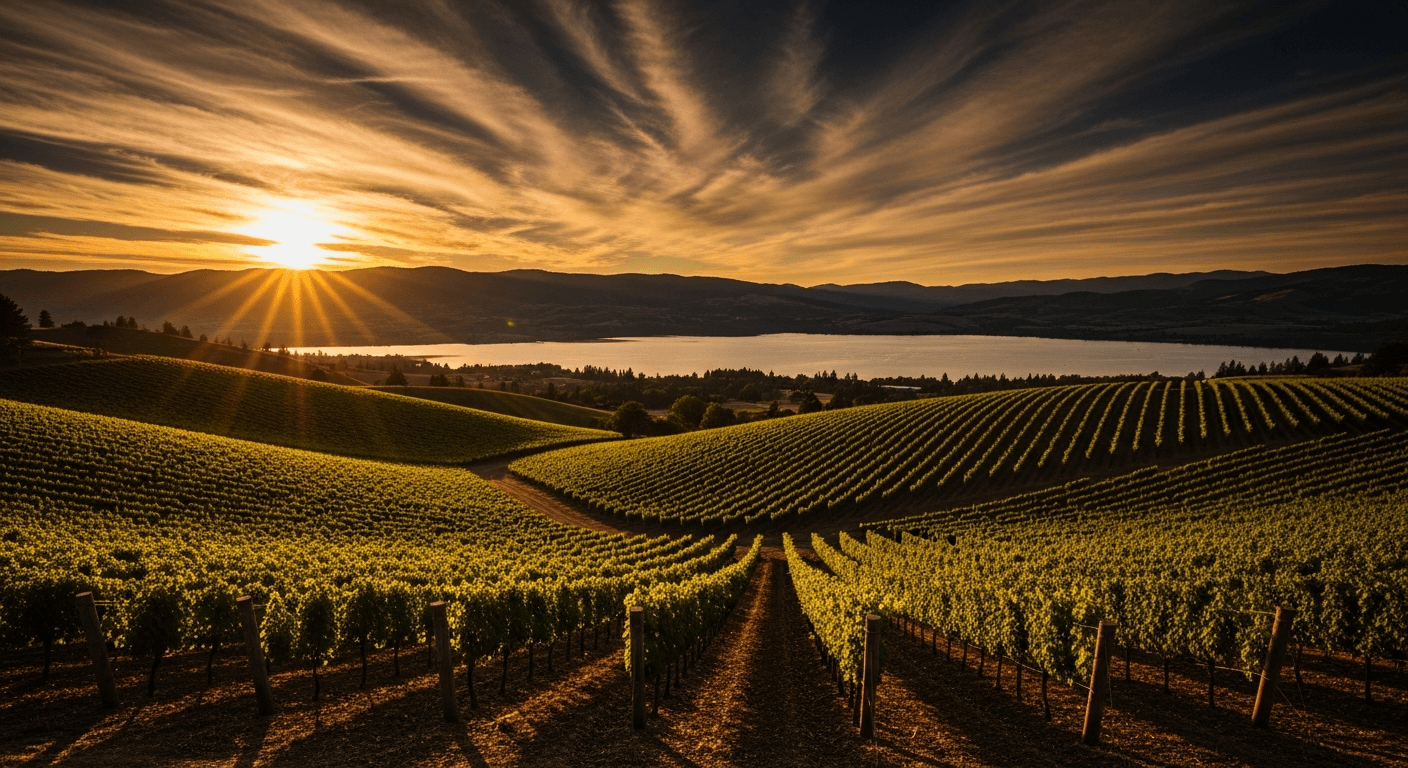
In a world saturated with familiar sparkling wines, there exists an Italian treasure, quietly effervescent, largely savoured by its homeland. Indeed, nearly 90% of Franciacorta's annual production is consumed within Italy, a testament to its domestic appreciation and, conversely, its relative obscurity on the global stage. This premium spumante, crafted with meticulous adherence to the Metodo Classico, consistently registers impressive sales, with approximately 18.9 million equivalent bottles released in 2025, yet remains an enigma to many international connoisseurs.
The Franciacorta region itself, nestled in Lombardy between the city of Brescia to the east, the Oglio river to the west, Lake Iseo to the north, and Mount Orfano to the south, boasts a unique terroir shaped by ancient glacial movements. This geological history has endowed the rolling hills with mineral-rich, well-drained soils, ideal for viticulture. The moderating influence of Lake Iseo creates a warm microclimate with cooling nighttime breezes, preserving the grapes' crucial acidity. The name 'Franciacorta' itself carries historical weight, first appearing in 1277 and stemming from 'francae curtes,' referring to medieval villages exempt from taxes.
While viticulture in Franciacorta dates back to Roman times, the region's modern sparkling wine identity began to crystallise in the mid-20th century. A pivotal moment arrived in 1961 when winemaker Franco Ziliani, collaborating with Guido Berlucchi, produced the first 3,000 bottles of méthode Champenoise (now known as metodo classico) sparkling wine in the region. This pioneering effort laid the groundwork for Franciacorta to achieve Denominazione di Origine Controllata (DOC) status in 1967, and subsequently, the prestigious Denominazione di Origine Controllata e Garantita (DOCG) in 1995, becoming the first Italian sparkling wine produced exclusively by the traditional method to earn this highest classification.
The Rigour of Metodo Classico
The production of Franciacorta is governed by some of Italy's most stringent regulations, ensuring a quality that is both consistent and expressive of its origin. Grapes are meticulously hand-harvested, with vineyard yields capped at 10 tons per hectare. The essential secondary fermentation, which generates the wine's delicate effervescence, occurs in the bottle. This is followed by an extended period of ageing sur lattes on its lees. For non-vintage Franciacorta, the minimum ageing requirement is 18 months, extending to 30 months for Millesimato (vintage) wines, and a remarkable 60 months for Riserva bottlings. This prolonged contact with the yeast imparts complex aromas of brioche, toasted nuts, and a characteristic richness.
Franciacorta wines are predominantly crafted from Chardonnay, which accounts for over 80% of vineyard plantings, alongside Pinot Nero (15-17%) and Pinot Bianco (3-5%). A recent addition, the indigenous white grape Erbamat, was permitted in 2019, contributing freshness and acidity to blends. The appellation offers several distinct styles. Franciacorta Satèn, made exclusively from white grapes (primarily Chardonnay with up to 50% Pinot Bianco), is notable for its lower bottle pressure, reaching a maximum of 5 atmospheres, which results in a softer, creamier mouthfeel and a minimum of 24 months on lees. Franciacorta Rosé, requiring a minimum of 35% Pinot Nero, undergoes at least 24 months of lees ageing, offering vibrant red fruit notes.
A Niche of Distinction
Despite its relatively modest production volume, Franciacorta has carved a niche for itself as a sparkling wine of discernible character and quality. While the domestic market remains its primary focus, accounting for 87.2% of total sales volumes in 2025, exports are steadily growing. Key international markets, including Switzerland (22.7% of total exports), Japan (12.6%), and the United States (12.2%), are increasingly recognising its pedigree. Its growing prestige is also underscored by its role as the official sparkling wine provider to the Emmy Awards since 2021.
For those seeking an alternative to more ubiquitous sparkling wines, Franciacorta presents a compelling proposition. Its stylistic versatility, from the crisp purity of a Pas Dosé to the rich complexity of a long-aged Riserva, ensures a suitable pairing for diverse culinary experiences. Notable producers such as Guido Berlucchi, Ca' del Bosco, Bellavista, and Barone Pizzini-which became the first organic Franciacorta producer in 1997-offer excellent introductions to the region's exceptional craftsmanship. To truly appreciate the breadth of Italian sparkling wine, one must look beyond the well-trodden paths and explore the quiet brilliance of Franciacorta.
More from the cellar.
Tasmania's Ascendant Sparkling Wines
Australia's cool-climate island is redefining premium Méthode Traditionnelle.
Aube's Ascent: Champagne's Southern Frontier
Once overlooked, this distinct southern region now drives Champagne's most dynamic shifts.
Champagne's Elite Villages: A Classification Unveiled
Discovering the 17 Grand Cru and 42 Premier Cru heartlands of Champagne.