Titanic's First-Class Champagnes: A Sweet Legacy
_Uncorking the opulent, often sweeter, sparkling wines enjoyed by the ill-fated liner's elite passengers._
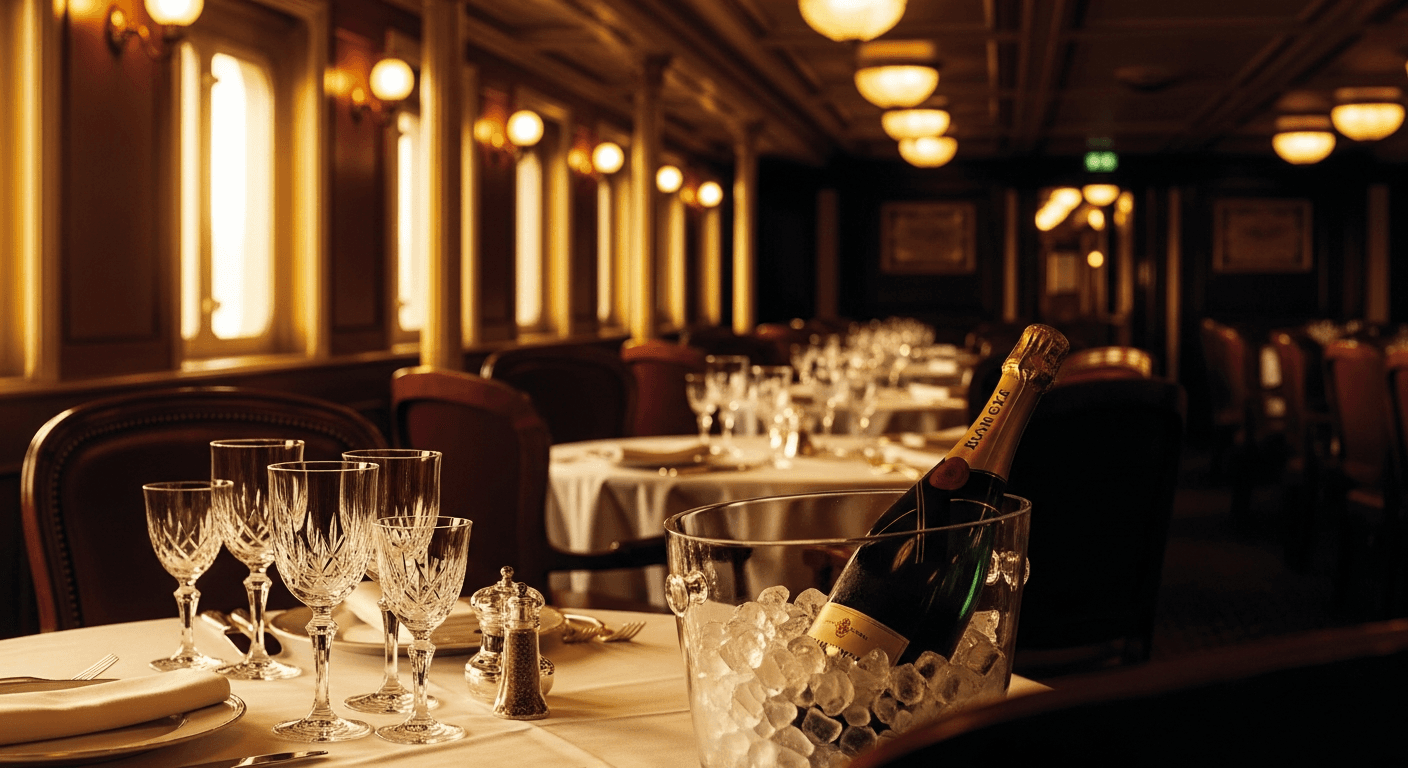
The prevailing image of Champagne today is one of crisp, dry elegance, epitomised by the ubiquitous Brut style. Yet, a century ago, palates often gravitated towards a decidedly sweeter expression. This historical preference is vividly illustrated by the champagnes poured in the first-class saloons of the RMS Titanic during its maiden-and-final voyage in April 1912, a liquid testament to an era of unbridled luxury and divergent tastes. Among the bottles recovered from the North Atlantic depths, one name stands out: Heidsieck & Co. Monopole Goût Américain 1907, a vintage far removed in sweetness from what most modern connoisseurs would expect.
Indeed, the Heidsieck & Co. Monopole Goût Américain 1907 was a prominent feature on the Titanic's extensive wine list, a specific vintage celebrated for its "American taste" - a descriptor indicating a significantly higher sugar content. This particular Cuvée boasted a Dosage between 100 and 165 grams per litre, a sweetness level that today would classify it as a Demi-Sec or even Doux, making it almost twice as sweet as a contemporary Sauternes. This very champagne was discovered remarkably preserved in the wreck of the Jönköping, a Swedish ship sunk by a German U-boat in the Baltic Sea in 1916, providing invaluable insight into its character decades later.
The Titanic, designed as the epitome of Edwardian opulence, carried an impressive inventory of beverages to cater to its affluent passengers. The White Star Line's ships typically offered around ten different Champagne brands, ensuring a diverse selection for the discerning clientele in first class. Beyond Champagne, the ship's meticulously curated cellar included prestigious Bordeaux reds, such as Château Lafite Rothschild or Château Margaux, alongside white Burgundies like Chablis and Montrachet, and German Rieslings. The sheer volume of spirits was substantial, with the vessel embarking from Southampton with approximately 1,500 bottles of wine, roughly half of which were Champagne, and a further 63 cases of Champagne listed in the cargo manifest.
First-class passengers indulged in these fine libations throughout their voyage. Champagne flowed freely in the elegant Smoking & Drinking Rooms, where gentlemen could enjoy a glass while playing cards and smoking cigars. Stewards were on standby to deliver drinks from adjacent bars, which operated from 8:30 AM until 11:30 PM, with the Smoking and Drinking Room closing at midnight. Furthermore, Champagne was an indispensable accompaniment to the lavish, multi-course dinners served in the grand dining saloon, reflecting its status as a symbol of luxury and social standing.
A Palate for Sweetness
The preference for sweeter Champagne in 1912 was not unique to the Titanic's passengers; it was a widespread trend. The Goût Américain style, with its elevated sugar content, was crafted to appeal to a market that favoured richness over the drier styles popularised later in the 20th century. When bottles of the 1907 Heidsieck & Co. Monopole Goût Américain were salvaged from the Jönköping wreck in 1998 and tasted, they exhibited a light yellow colour, a fine mousse, and a well-matured nose with notes of citrus, hazelnuts, and brioche, culminating in a soft, sweet taste. This profile stands in stark contrast to the Brut Champagnes that dominate today's market, which typically contain a Dosage of less than 12 grams per litre.
The Deep Cellar
The extraordinary preservation of these historical bottles, particularly those from the Jönköping, offers a compelling lesson in ideal cellaring conditions. Resting undisturbed at a depth of 60 to 65 metres in the Baltic Sea, the bottles experienced a constant temperature of around 4 °C and complete darkness. Crucially, the external pressure at this depth, approximately six atmospheres, nearly matched the internal pressure of the Champagne, preventing cork degradation and preserving the wine's effervescence. These fortuitous circumstances meant that after more than 80 years underwater, the Champagne remained remarkably youthful and drinkable, a testament to the sea's unique ability to act as a perfect, albeit unintended, cellar.
Today, the legacy of the Titanic's Champagnes continues to captivate, prompting a renewed appreciation for historical wine styles. While the original 1907 Heidsieck & Co. Monopole Goût Américain bottles are now priceless artefacts, commanding significant sums at auction, the house has since revived the "Goût Américain" style, albeit with a toned-down sweetness more aligned with modern palates. This revival allows contemporary enthusiasts to experience a taste of the past, offering a glimpse into the preferences of an era defined by grandeur and, ultimately, tragedy. The story of Titanic's Champagnes is not merely about luxury; it is a profound narrative of changing tastes, remarkable preservation, and the enduring human connection to wine's rich history.
More from the cellar.
Bubbly Echoes of Paris's Lost Generation
_Champagne fuelled the literary and artistic ferment of 1920s expatriate Paris._
Bond and Bollinger: A Vintage Alliance Forged in '73
How a single cinematic moment cemented Champagne Bollinger's enduring legacy with 007.
Churchill's Champagne: A 42-Year Devotion
The enduring legacy of Sir Winston Churchill's profound bond with Pol Roger.