The Clear Vision: Veuve Clicquot and Riddling's Genesis
A pioneering widow's ingenuity transformed Champagne from cloudy beverage to crystal-clear luxury.
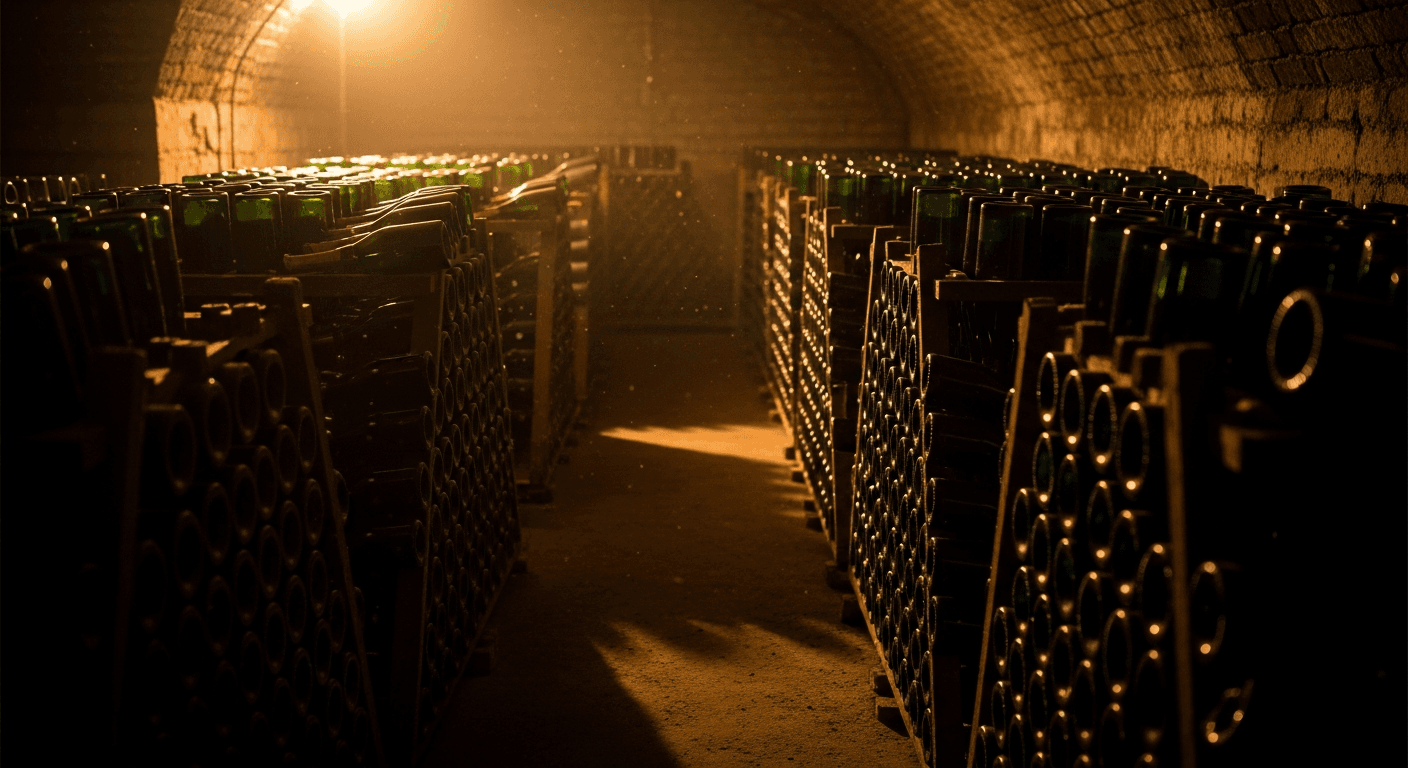
Before the advent of remuage, the sparkling wines of Champagne, while effervescent, were often marred by an unsightly cloudiness. This opaqueness, caused by the lees-the spent yeast cells remaining after secondary fermentation in the bottle-presented a significant challenge to producers and a less appealing experience for discerning drinkers. The very act of pouring a glass might stir up a flurry of sediment, diminishing the wine's allure and marketability. Indeed, early Champagne was far from the pristine liquid we recognise today, frequently resembling cloudy cider or apple juice.
It was into this nascent, somewhat rustic world of sparkling wine that Barbe-Nicole Ponsardin Clicquot, better known as Madame Clicquot, stepped. Widowed at the age of just 27 in 1805, she defied the restrictive societal norms for women of the 19th century, taking the reins of her late husband's Champagne house. Her drive for excellence was unwavering, encapsulated by her maxim: 'Our wines must be flattering both to the palate and to the eye.' This pursuit of perfection led her to confront the persistent problem of sediment, aiming to produce a wine of unparalleled clarity.
Madame Clicquot, with the crucial assistance of her skilled cellar master, Antoine Muller (also referred to as Antoine-Aloys de Muller), sought a systematic solution. Their groundbreaking work culminated in the invention of the first riddling table, or pupitre, in 1816. This innovative device, legendarily conceived from a kitchen table with holes drilled at varying angles, provided a structured way to manipulate the bottles. It was a simple yet profoundly effective design, comprising two hinged wooden boards with a series of tapering, angled openings, capable of holding approximately 120 bottles.
The Art of Remuage
The process, known as remuage or riddling, begins with bottles laid horizontally (sur lattes) after their period of maturation sur lie, which typically lasts for at least 15 months for non-vintage Champagne and often much longer for vintage expressions, such as Veuve Clicquot's La Grande Dame, aged for a minimum of seven years. The bottles are then gradually inserted into the pupitre, initially at a shallow angle of around 20-25 degrees. Over a period of several weeks-typically four to six for manual riddling-a dedicated remueur meticulously rotates each bottle by a fraction (an eighth, a quarter, or a sixteenth of a turn) while simultaneously increasing its angle, moving it towards a vertical, neck-down position (sur pointe).
This precise, daily manipulation, often involving around 25 turns per bottle, causes the yeast sediment to detach from the bottle's inner surface and slowly descend, collecting neatly in the neck against the temporary crown cap. The efficacy of this technique relies on gravity and the delicate 'flick of the wrist' (coup de poignet) of the remueur, ensuring that even the finest particles (léger) are guided towards the neck. Once the sediment is concentrated, the bottle necks are chilled to around -27 °C to freeze the yeast into a solid plug, facilitating its expulsion during the subsequent dégorgement process.
A Legacy of Clarity and Efficiency
The invention of the riddling table marked a pivotal moment, transforming Champagne from a cloudy, inconsistent beverage into a clear, elegant one. This clarity was not merely an aesthetic improvement; it significantly enhanced Champagne's marketability and appeal across European courts and beyond, notably in Imperial Russia where Madame Clicquot's wines found great favour. The remuage method streamlined production, making the clarification process more efficient and economical, thereby enabling the house of Veuve Clicquot to produce and export larger quantities of consistently high-quality sparkling wine.
While manual remuage remains a revered skill, with master remueurs capable of handling tens of thousands of bottles a day (some sources suggest up to 75,000-80,000 bottles daily), the majority of Champagne houses today employ automated gyropalettes. These machines, first patented in 1968 and widely adopted since the 1970s, can riddle 504 bottles simultaneously, completing the process in a mere seven to ten days, a significant acceleration compared to the manual method's six weeks. Yet, for some prestige Cuvées and large format bottles, the artisanal touch of manual riddling persists, a testament to its enduring legacy.
Madame Clicquot's audacious spirit extended beyond riddling; she also pioneered the first known vintage Champagne in 1810 and created the first blended rosé Champagne in 1818 by adding red wine to white, a method still widely used. Today, as one savours a glass of clear, effervescent Champagne, it is a direct nod to her 1816 innovation. The next time a Cuvée of Veuve Clicquot, or any Méthode Traditionnelle sparkling wine, sparkles in the glass, consider the transformative journey from cloudy ferment to liquid brilliance-a legacy born from the determination of one remarkable woman and a simple, yet revolutionary, wooden table.
More from the cellar.
Bottle Shock: The Unseen Travail of Transported Wine
Unravelling the debate: does wine truly need repose after its journey?
Tasmania's Ascendant Sparkling Wines
Australia's cool-climate island is redefining premium Méthode Traditionnelle.
Non-Vintage: A Cellar Master's Legacy
Behind Champagne's enduring house style lies the profound skill of its guardian.