Sabrage: The Hussar's Sparkling Art
Uncorking history with a blade, a precise blend of physics and panache.
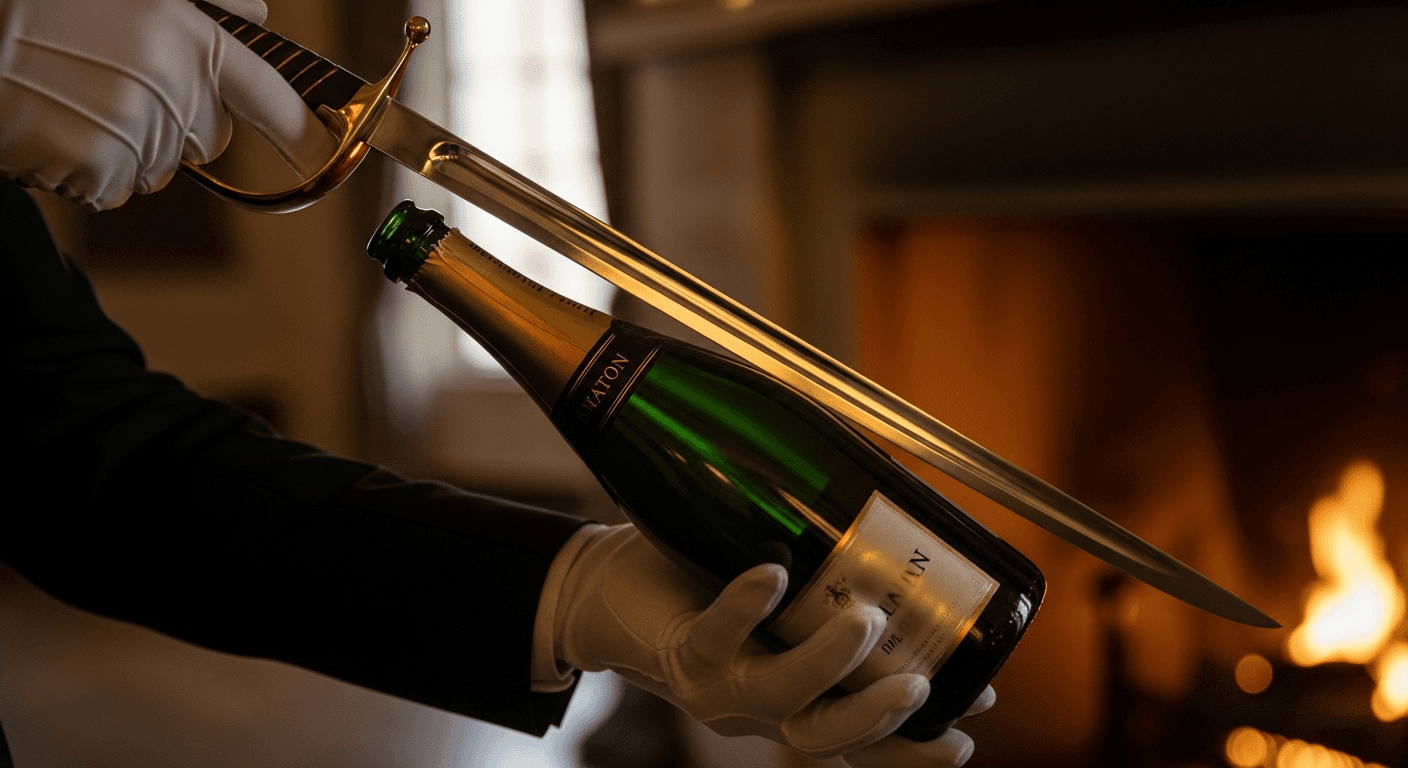
The sight of a cavalry officer, saber glinting, swiftly decapitating a bottle of Champagne conjures an image of audacious revelry. This dramatic act, known as sabrage, appears to be a feat of brute force, yet its success hinges on an elegant interplay of physics and precision, far removed from mere bravado. While historically linked to military triumph, the controlled spectacle of sabrage today offers a refined method for opening sparkling wine, demanding respect for its inherent power.
Indeed, the origins of sabrage are steeped in the Napoleonic Wars of the early 19th century. Legend recounts that Napoleon's light cavalry, the Hussars, celebrated their victories by opening Champagne bottles with their sabers. Whether offered Champagne by grateful villagers or by the enterprising young widow Madame Clicquot, these officers, often still on horseback, required a swift and practical method to enjoy their celebratory libation, leading to the development of this distinctive technique. Napoleon Bonaparte himself is famously quoted, "Champagne! In victory one deserves it; in defeat one needs it."
At the heart of sabrage lies not the sharpness of the blade, but the immense internal pressure within a bottle of sparkling wine. A typical Champagne bottle holds approximately 5 to 6 atmospheres of pressure, equivalent to around 90 pounds per square inch (psi) - roughly three times that of a standard car tyre. This formidable force, generated during the Méthode Champenoise or Méthode Traditionnelle secondary fermentation, is harnessed when the blunt edge of a saber (or even a sturdy kitchen knife) strikes the bottle's weakest point: the lip where the vertical seam meets the neck. The impact creates a stress concentration, initiating a microscopic fracture that rapidly propagates around the bottle's circumference, cleanly separating the collar of glass and cork.
Preparing the Bottle for Sabrage
Successful and safe sabrage begins with meticulous preparation. The bottle must be thoroughly chilled, ideally to a temperature between 3 °C and 8 °C (38-46 °F). This ensures the glass is brittle enough for a clean break and helps to stabilise the internal pressure, minimising excessive foaming. For optimal results, refrigerate the bottle for at least 24 hours, or immerse it neck-down in an ice bucket for 30-60 minutes to ensure even cooling. Crucially, the bottle should be completely dry before proceeding, as a firm grip is paramount. Next, carefully remove all foil and the wire cage (muselet) from the cork, ensuring an unobstructed path for the saber. Locate one of the two vertical seams running the length of the bottle, as this will serve as your guide.
Executing the Strike
With the bottle prepared, grip it firmly at the base with your non-dominant hand, placing your thumb in the punt for stability. Angle the bottle upwards at approximately 30-45 degrees, pointing it well away from people, pets, and any fragile objects; the cork and glass collar can travel up to 15 metres (49 feet) at high velocity. Position the blunt edge of your saber flat against the bottle, aligning it with the seam. Take a few practice strokes without making contact to familiarise yourself with the trajectory. When ready, execute a smooth, confident, and swift sliding motion along the seam, striking the lip where it meets the neck. The key is a fluid follow-through, as if slicing through the air beyond the bottle, rather than a chopping motion. The pressure within will do the work, propelling the cork and glass collar cleanly away.
While the spectacle is undeniably appealing, safety must remain paramount. Always perform sabrage outdoors in an open, clear area, and consider wearing protective eyewear. Not all sparkling wines are suitable; opt for those produced via Méthode Traditionnelle, such as Champagne, Crémant, Cava, or Franciacorta, which are crafted in robust bottles designed to withstand high internal pressures. Wines like Prosecco or Asti, typically made using the Charmat method and bottled with lower pressures, are generally not recommended for sabrage due to their thinner glass and less predictable breakage patterns. After a successful sabrage, inspect the bottle opening for any minute glass fragments before pouring, though the outward force of the wine usually expels any shards.
From the battlefields of 19th-century France to contemporary celebrations, sabrage continues to captivate. Today, organisations like the Confrérie du Sabre d'Or, founded in France in 1986, perpetuate this tradition, initiating thousands into its ranks worldwide. Whether at a grand wedding, a milestone anniversary, or simply an intimate gathering, the ceremonial uncorking of a Brut or Cuvée can transform a moment into a lasting memory. It is a reminder that even the most refined pleasures can carry a thrilling edge, if approached with knowledge and respect.
More from the cellar.
Bubbly Echoes of Paris's Lost Generation
_Champagne fuelled the literary and artistic ferment of 1920s expatriate Paris._
Bond and Bollinger: A Vintage Alliance Forged in '73
How a single cinematic moment cemented Champagne Bollinger's enduring legacy with 007.
Churchill's Champagne: A 42-Year Devotion
The enduring legacy of Sir Winston Churchill's profound bond with Pol Roger.