Beyond the Bottle: Champagne's Grand Formats
Uncorking the science and spectacle behind Champagne's diverse bottle sizes.
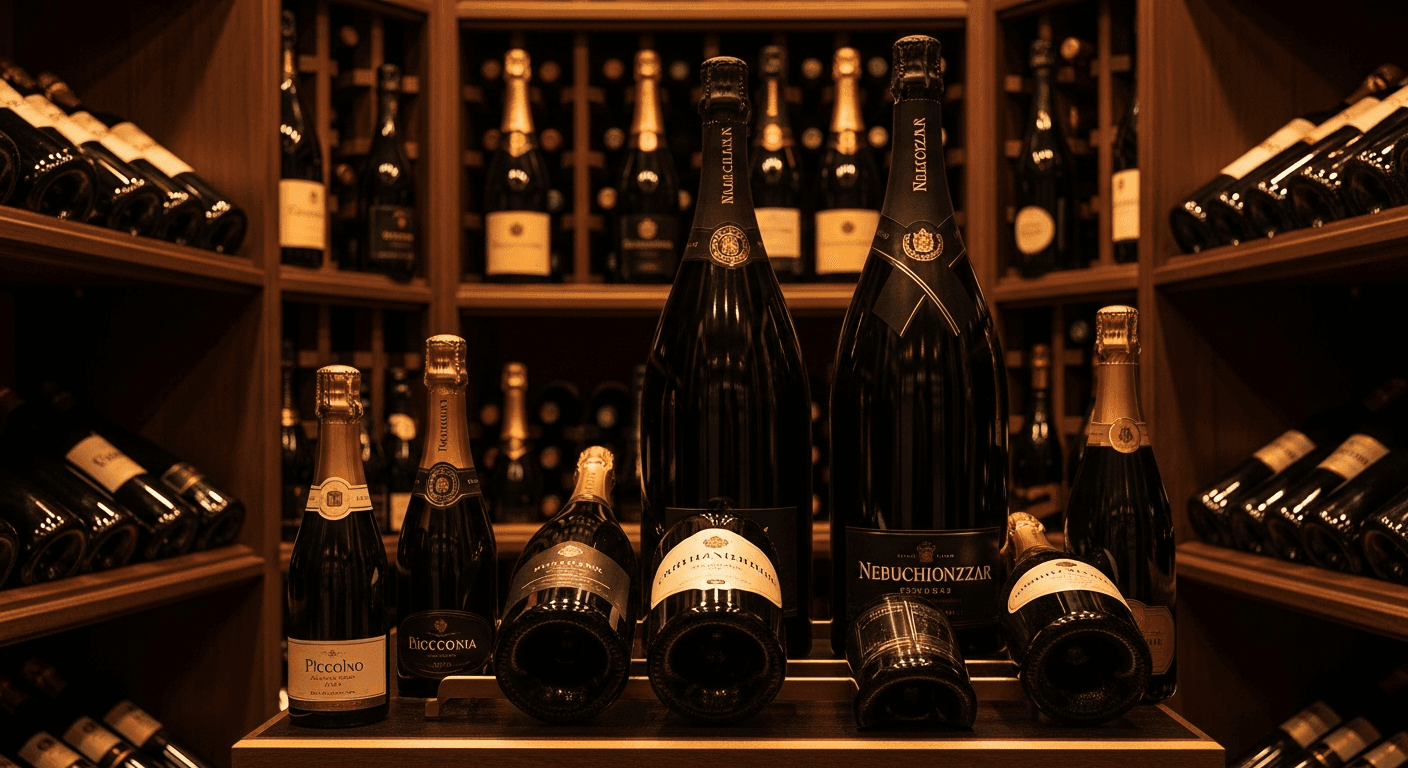
It is a peculiar truth in the world of fine wine that, for all the meticulous attention paid to terroir, grape variety, and winemaking technique, the vessel itself can wield a profound influence on the liquid within. Consider Champagne, where the standard 750 ml bottle, while ubiquitous, is often overshadowed in terms of aging potential by its larger siblings. The difference is not merely aesthetic; it is rooted in the physics of oxygen ingress and the delicate process of secondary fermentation and autolyse in bottle.
At the heart of this phenomenon lies the Magnum, a 1.5 L bottle holding twice the volume of a standard format. Esteemed Champagne houses consistently favour the Magnum for extended aging of their finest Cuvées, a practice underpinned by sound scientific reasoning. The surface area of the cork in a Magnum is proportionally smaller relative to the increased volume of wine, leading to a significantly reduced oxygen-to-wine ratio. This slower, more controlled oxidative development allows the Champagne to evolve with greater complexity, retaining freshness and achieving a finer, more persistent mousse over time. Vitalie Taittinger, Artistic Director of Champagne Taittinger, has affirmed the Magnum as having the 'best ratio between air and wine' for optimal aging potential.
Beyond the celebrated Magnum, the hierarchy of Champagne bottle sizes ascends to truly monumental proportions, often bearing names derived from biblical kings and patriarchs, symbolising grandeur and longevity. The Jeroboam, holding 3 L, is equivalent to four standard bottles and is frequently chosen for significant celebrations. Its name traces back to Jeroboam I, the first king of the northern kingdom of Israel in the 10th century BC, and was first recorded for an oversized wine bottle in Bordeaux in 1725. While impressive, the Jeroboam continues to benefit from the reduced oxygen exposure inherent in larger formats, allowing for a more harmonious aging trajectory.
The Grandeur of Giants
Moving further up the scale, we encounter the Balthazar, a colossal 12 L bottle, equivalent to sixteen standard bottles. This majestic format is named after one of the Three Wise Men who, according to tradition, visited the nativity. Such bottles, weighing nearly 40 pounds when full, are typically reserved for grand-scale events and require considerable effort to handle and pour. Their rarity and sheer presence transform any occasion into an unforgettable spectacle.
The apex of these named Champagne bottles is often the Nebuchadnezzar, a truly extraordinary 15 L vessel, holding the equivalent of twenty standard bottles. Named after Nebuchadnezzar II, the powerful King of the Neo-Babylonian Empire who reigned from 605 BC to 562 BC, this bottle embodies immense power and magnificence. These ultimate statement bottles are almost exclusively special-order items, requiring weeks or months of notice for specific vintages, and are primarily seen at the most prestigious galas or luxury yacht parties.
The Petite Counterpart
At the other end of the spectrum is the Piccolo, a diminutive 187 ml or 200 ml bottle. Meaning 'small' in Italian, the Piccolo is often referred to as a quarter bottle or split, perfectly suited for a single serving or an individual glass. While offering convenience for minibars or in-flight service, these smaller formats do not offer the same aging advantages as their larger counterparts. The higher ratio of oxygen to wine in a Piccolo accelerates the aging process, meaning these are best enjoyed closer to their release to preserve their youthful vibrancy and effervescence.
The profound impact of bottle size on Champagne's development is a testament to the intricate balance of factors influencing this celebrated sparkling wine. Beyond the oxygen ratio, larger bottles also boast greater thermal mass, providing enhanced protection against temperature fluctuations during storage. This stability contributes to a more graceful evolution, allowing the Champagne to develop a richer texture and deeper flavours over time. Laurent Fresnet, cellar master of Champagne Henriot, notes that Magnums are often released later than their 750 ml equivalents, allowing consumers to experience already-aged Champagne.
Ultimately, the choice of Champagne bottle size extends beyond mere volume; it dictates the wine's journey of maturation and defines the tone of the occasion. While the Piccolo offers instant gratification, and the Jeroboam provides a celebratory centrepiece, the Magnum stands as the connoisseur's preferred format for unlocking Champagne's full aging potential. Next time you select a bottle, consider the narrative its size tells - whether it is a fleeting toast or a grand, enduring statement, the vessel itself is integral to the sparkling experience.
More from the cellar.
Bubbly Echoes of Paris's Lost Generation
_Champagne fuelled the literary and artistic ferment of 1920s expatriate Paris._
Bond and Bollinger: A Vintage Alliance Forged in '73
How a single cinematic moment cemented Champagne Bollinger's enduring legacy with 007.
Churchill's Champagne: A 42-Year Devotion
The enduring legacy of Sir Winston Churchill's profound bond with Pol Roger.