The Enduring Grip: Cork and Cage Evolution
From volatile closures to precision engineering, the sparkling wine stopper's journey unfolds.
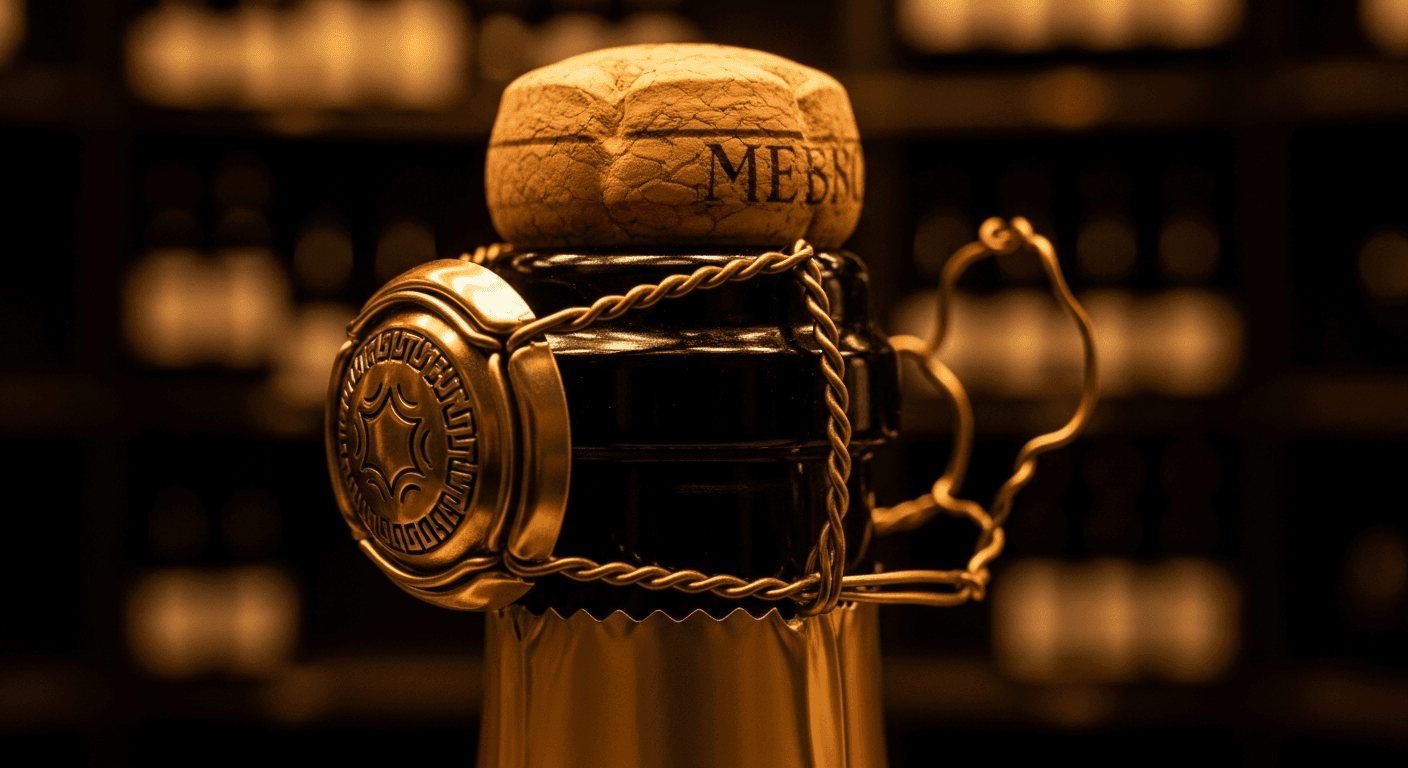
Before the elegant pop of a Champagne cork became synonymous with celebration, it was often a sound of peril. In the 17th and 18th centuries, the burgeoning effervescence of vins mousseux presented a formidable challenge: how to contain the formidable pressure of refermentation within the bottle. Early winemakers resorted to wooden plugs wrapped in oil-soaked hemp, then later cylindrical corks secured with brittle twine, which frequently failed. This led to the phenomenon known as 'devil's wine,' where bottles spontaneously exploded or corks ejected violently, forcing cellar workers to don wire-reinforced masks for protection. The industry desperately sought a more reliable solution to tame this effervescent force.
The decisive turning point arrived in 1844, when Adolphe Jacquesson, a visionary merchant from Châlons-en-Champagne, patented the ingenious device known as the muselet, or wire cage. Derived from the French word 'museler,' meaning 'to muzzle,' this innovation finally provided a secure restraint for the cork, preventing premature expulsion and revolutionising the safe storage and transport of sparkling wines. Jacquesson's patent, filed on 5 July 1844, also introduced the metal plaque that sits atop the cork, protecting it from the wire and providing a surface for branding.
Yet, the cork itself underwent significant evolution. While natural cork stoppers were first documented in Champagne as early as 1662, their initial form was a simple cylinder. By the 19th century, increased demand for cork, coupled with a reduction in bark quality, necessitated a new approach. Modern Champagne corks, which start as perfectly cylindrical pieces approximately 48 mm long and 30-30.5 mm in diameter, are typically composite. They feature an agglomerated body made from cork granules, topped with one to three discs of pristine natural cork, known as miroirs or rondelles, which directly contact the wine. This design allows the cork to be compressed to about 17 mm for insertion, subsequently expanding to form the iconic mushroom shape under the bottle's internal pressure of 5-6 bar.
Refinement and Automation
The early muselets, while a vast improvement, were far from the easily manipulable cages we know today. They proved somewhat inconvenient to install and open, requiring further refinement throughout the 19th century. It was not until around 1880 that the first modern wire cages began to appear, initially supplementing the traditional string ties. A crucial development came in 1884, when René Lebegue, an engineer at Moët & Chandon, introduced the design featuring a small wire loop in the lower ring, which, when twisted six half-turns anticlockwise, would release the cage and cork. This ingenious mechanism remains the standard practice, a testament to its enduring functionality.
The 20th century brought significant advancements in the manufacturing process. The Cortellazzi brothers in Italy developed the first semi-automatic machine for muselet production in 1952, enabling the creation of all three components from a single piece of metal wire. This innovation was followed by the introduction of fully automated machines in the 1960s and 1970s, capable of attaching wire cages to tens of thousands of bottles per hour. Today, these high-speed bottling lines ensure that the muselet remains a ubiquitous and efficient component of sparkling wine production globally.
Beyond Tradition: Modern Closures
The metal plaque, initially a functional element, quickly evolved into a canvas for branding and an object of collection. Champagne Pol Roger was among the first to feature a uniquely designed cap in 1906, paving the way for the intricate and diverse designs seen today. The dedicated hobby of collecting these small metal discs is known as Placomusophilia, a pursuit that highlights the aesthetic and historical value imbued in these humble closures.
While the cork and muselet remain the quintessential closure for Champagne and many other Méthode Traditionnelle sparkling wines, innovation continues. Some producers now opt for crown caps, particularly for certain styles or during earlier stages of élevage, appreciating their reliability and airtight seal. Furthermore, advancements in re-sealing technology, such as the Coravin Sparkling system, offer consumers the ability to preserve an opened bottle's effervescence for weeks by injecting pure CO₂. These modern solutions cater to evolving consumption habits, allowing for a single glass without compromising the rest of the Cuvée.
As you next uncork a bottle of fine sparkling wine, take a moment to appreciate the intricate engineering and centuries of ingenuity held within its closure. The humble cork and its steel muselet are not merely functional components; they are a legacy of dedication, a testament to overcoming significant challenges, and a silent promise of the joyous effervescence within. Whether it is a classic Brut from a celebrated Maison or an artisanal Crémant, the closure embodies a rich history that enhances every pour.
More from the cellar.

Bottle Shock: The Unseen Travail of Transported Wine
Unravelling the debate: does wine truly need repose after its journey?

The Enduring Effervescence of an Open Bottle
Unravelling the science and art of preserving sparkling wine's ephemeral magic.
The Silent Saboteurs of Sparkling Grandeur
Preserving the delicate effervescence of Champagne demands precise, consistent care.